

AI Tutorial: A Guide to AI LLMs, from Basics to Depth #
This article takes you deep into the core concepts of large language models — from basic principles to vector representation — building a complete knowledge system step by step.
1. Foundations of AI Application Development #
1.1 Basic Principles and Concepts #
In Plain Words #
- Core mechanism: predict the next word from the previous one — like a word-chain game
- How it works: output is generated token by token
A Deeper Look #
A large AI model involves two key stages:
| Stage | Analogy | What it does |
|---|---|---|
| Training | Learning | Read massive amounts of data to build the model and stock its knowledge |
| Inference | Applying | Generate responses from input and deliver the service |
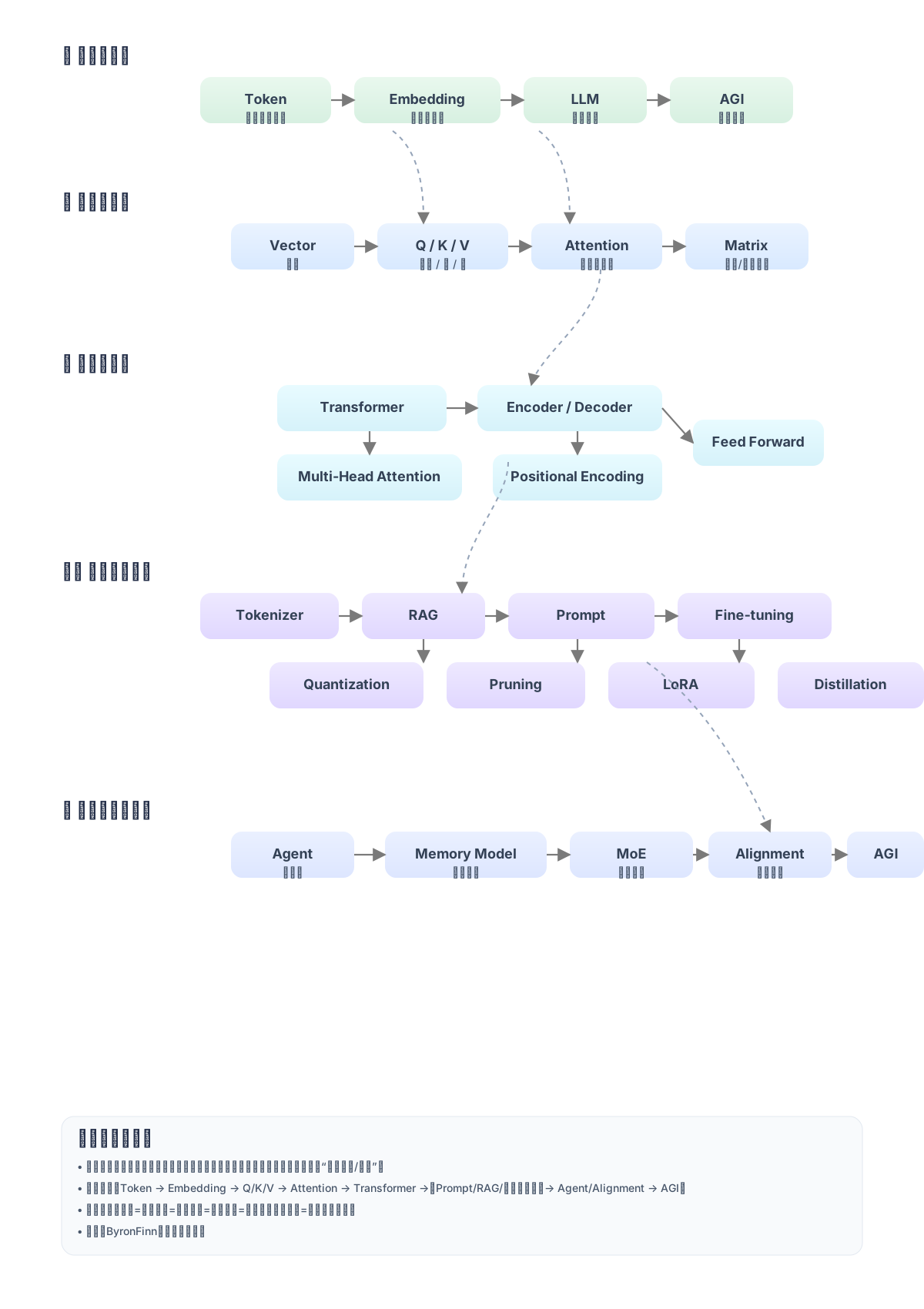
Core Technical Components #
-
Transformer architecture
- Made of an encoder and a decoder
- The core is the attention mechanism, which enables efficient information processing
-
Embedding and positional encoding
- Convert text into numeric vectors a computer can process
- Add ordering information so the model understands sequence in language
-
Multi-head attention
- The core computational step
- Decides which content matters more, which in turn shapes the output
2. Core Concepts #
2.1 Basic Terms #
- AGI (Artificial General Intelligence): the end goal of large models — human-level intelligence
- LLM (Large Language Model): short for large language model
- Chat products vs LLMs: the difference between the application layer and the model layer
2.2 How Models and Products Relate #
| Analogy | Concept | Role |
|---|---|---|
| The brain | LLM | Powerful understanding and generation capacity |
| App / product | Chat product | Makes the model easy and safe for ordinary people to use |
3. Tokens: The Smallest Unit of AI Language #
3.1 What Is a Token? #
A token = the smallest unit of text a model processes. It is neither strictly a character nor a fixed word — it is a fragment cut out of the text by a compression scheme.
How tokens are split #
-
English: usually split into word fragments
"I love apples"→["I", " love", " apple", "s"]
-
Chinese: usually split by character or short word
"我喜欢苹果"→["我", "喜欢", "苹果"]- (the exact granularity depends on the tokenizer)
-
Special tokens: start/end markers, newlines, tool-call boundaries, and so on
💡 Intuition: tokens are like the particles of AI language — a model reads and generates one token at a time.
3.2 How Are Tokens Cut? #
Most LLMs use algorithms such as BPE/Unigram:
- Find the most frequent character combinations in the text and assign each a vocabulary ID
- This way both single characters and common words or word fragments can be represented
- It balances efficiency (fewer tokens) against generalization (rare words can still be split apart)
⚠️ Important: the same sentence may produce a different token count under different models or vocabularies.
3.3 How Tokens Affect Products #
| Factor | How it shows up | Optimization strategy |
|---|---|---|
| Length limits | A model can only read/hold a capped number of tokens per call | Truncate or retrieve in batches |
| Cost | Most commercial LLMs bill by token count | Refine prompts, cut wasted tokens |
| Speed | Output streams out token by token | Control output length, reduce latency |
| Quality | Sensible token control noticeably improves results | Clean prompts, curate retrieved content |
📊 Rules of Thumb for Token Estimation #
- English: ~3-4 words ≈ 1 token (100 tokens ≈ 75 English words)
- Chinese: 1 character/word ≈ 0.6 tokens (varies by vocabulary)
- Note: for real counts, always defer to the specific model’s tokenizer
4. Vectors: The Foundation of AI Understanding #
4.1 What Is a Vector? #
In mathematics, a vector is a quantity with both magnitude and direction — or, more generally, an ordered list of numbers.
The simplest vector can be written as:
|
|
This means:
- Move 2 units along the x axis
- Move 3 units along the y axis
It can represent the position of a point (an offset relative to the origin), or an arrow starting at the origin (direction + length).
4.2 🧭 A Geometric Example #
Imagine walking around on a plane:
- The vector (2, 3) means “walk right 2, walk up 3”
- The vector (-1, 4) means “walk left 1, walk up 4”
These numbers act like coordinates, telling you where to go in space.
📊 Draw it out:
- Origin at (0, 0)
- Endpoint at (2, 3) → the arrow pointing there is the “vector”
4.3 💡 Vectors as Features #
When we apply this concept to AI, a vector is no longer just a position — it can represent features or meaning.
Example 1: color vectors #
Suppose we describe a color’s red, green, and blue components with 3 numbers:
|
|
This is a 3-dimensional vector space. Every color is a 3-D point in that space, which lets us compute similarity between colors.
Example 2: human feature vectors #
Suppose we want to describe a person with numbers:
| Feature | Meaning | Value |
|---|---|---|
| Age | years | 25 |
| Height | cm | 180 |
| Weight | kg | 70 |
A person then becomes (25, 180, 70) — again a 3-dimensional vector. To compare how alike two people are, we compute the distance between their vectors.
For example:
|
|
Their vector distance is small → the two have similar features.
Example 3: semantic vectors for words #
In natural language processing (NLP), models turn every word into a high-dimensional vector (say, 768 dimensions).
| Word | Vector (excerpt) |
|---|---|
| king | [0.25, -0.12, 0.78, …] |
| queen | [0.27, -0.10, 0.74, …] |
| man | [0.30, -0.15, 0.70, …] |
| woman | [0.28, -0.13, 0.72, …] |
The model then discovers:
king - man + woman ≈ queen
In other words, mathematical relations between vectors can express semantic relations. That is why we say:
Vectors let machines understand meaning, not merely see text.
5. Token Management in the LLM Workflow #
5.1 The End-to-End Workflow #
Here is the main pipeline of a conversational Q&A application (with each step’s relationship to tokens):
1. User input #
- Raw text: for example, “help me write a post-interview thank-you email”
- ✅ Key point: length is uncontrollable — clean up and cap it downstream
2. Preprocessing (cleaning / structuring) #
- Strip meaningless whitespace and normalize the text format
- Inject role/tone requirements (prompt templating)
- ✅ Key point: fewer dirty tokens — convey intent more clearly with fewer tokens
3. Retrieval (optional: RAG) #
- Vectorize the user’s question → find relevant documents in a vector store → bring back several passages
- Splice those passages into the prompt as context
- ✅ Key point: retrieved passages must be trimmed and summarized, or you risk blowing the context window
4. Assemble the final prompt (input sequence) #
- Composition:
system instructions + tool/function definitions + retrieved evidence + conversation history + the current user question - Then the tokenizer cuts all of it into tokens
- ✅ Key point: count input tokens; when close to the limit:
- keep the most relevant evidence first
- summarize / sliding-window the history
- cap generation (max_tokens)
5. Model forward pass and the generation loop (decoding) #
-
The model reads the input tokens → outputs a probability distribution over the next token
-
A sampling strategy (greedy/temperature/top-p…) picks the next token
-
The new token is appended to the context, and the next one is predicted — round and round
-
Until a stop condition is met: an end token appears / max_tokens is reached / a stop word is hit
-
✅ Key point:
- Output tokens are produced as a stream
- The more divergent the sampling (high
temperature), the more tokens and the livelier the style may get - A sensible
max_tokenscontrols cost and latency
6. Detokenization #
- The model outputs a token sequence that must be turned back into a text string
- ✅ Key point: seemingly trivial spaces and indentation are actually part of tokens
7. Post-processing #
- Structured extraction, formatting into Markdown/JSON
- Sensitive-information / compliance filtering
- Summarizing results or multi-round tool calls
- ✅ Key point: cutting wasted output tokens lowers cost and speeds things up
8. Logging and billing #
- Record input/output token counts, latency, failures, and retries
- Combine with quality metrics to iterate on prompts and retrieval strategy
🔄 Flow diagram:
5.2 🎯 Real-World Case Studies #
Case 1: why long context does not mean high quality #
- Problem: stuff all 20 pages of a document into the prompt, token count explodes → forced to truncate
- Result: the 2 most relevant passages get dropped
- Fix: retrieval + passage scoring + summarization — keep the most critical information with fewer tokens
Case 2: controlling cost and latency #
- Need: the user only wants a bullet list — there is no reason to let the model write 1,000 tokens of prose
- Strategy: set
max_tokens=120+ prompt it with “answer in 6 bullets, each 20 words or fewer” - Effect: cost and latency drop immediately, and the output matches the need
Case 3: how Chinese and English tokens differ in practice #
- Observation: 100 Chinese characters and 100 English words usually produce different token counts
- Advice: at the product level, do rate limiting and budgeting based on real token counts
5.3 🛠️ Product and Engineering Playbook #
Core strategies #
- Count tokens in real time: count once after assembling the prompt and before calling the model; near the limit, trigger a trimming strategy
- Layered context: system instructions (short and stable) + highly relevant evidence (short and sharp) + recent dialogue turns (after summarization)
- Output caps and stop words: configure
max_tokensand stop words per scenario to keep answers from rambling - Cap retrieved passage length: set a maximum token count per passage and trim within sentences (keep only a few words around each hit)
- Metrics loop: log
input_tokens/output_tokens/latency/success_rateand A/B test prompts and retrieval strategies - Multilingual scenarios: token efficiency differs across languages; when necessary, do language detection + translation into a single language before the model sees the input
6. 🧠 Key Takeaways #
6.1 Concepts at a Glance #
| Concept | In one sentence |
|---|---|
| Token | The particles of AI language — all length, speed, and cost revolve around them |
| Vector | Meaning in numeric form, letting machines grasp semantic relations |
| Transformer | The core architecture of modern AI, processing information through attention |
6.2 Recap #
- Basic principle: predict the next word, generate token by token
- Core architecture: Transformer + attention mechanism
- Key concept: vector representation lets machines understand semantics
- Real-world use: the complete chain from model to product
- Token management: the key to controlling length, cost, and quality
6.3 💡 Study Advice #
- Understand the token concept: a crucial step into AI — tokens underpin how modern models process language
- Practice token optimization: in product development, good token management markedly improves results and lowers cost
- Master vector representation: understand how human language becomes math a machine can digest
🚀 Next step: if you’d like, I can draw you a diagram of the LLM workflow and its token interaction points, or write a small script that counts tokens for a given text across different models and estimates cost and latency.
📚 Further Reading #
🔗 AI LLM Systematic Tutorials Series #
- [This post] A Complete Guide to AI LLMs — tokens and vectors explained in depth, from the ground up
- Transformer Architecture Deep Dive — the attention mechanism and the core technology behind LLMs
- Prompt Engineering Complete Guide — a hands-on guide from prompt engineering to context engineering
- AI Technical Glossary — 270+ terms and a dictionary of the AI technology landscape
🎯 Suggested Learning Path #
- Beginners: read this post first for the fundamentals, then use the glossary to consolidate terminology
- Developers: after this post, focus on the Prompt Engineering hands-on guide
- Researchers: go deep on the Transformer architecture to master the core principles of AI