
Immortality Is Just Eternal Loneliness #
Today I saw a piece in the NT saying that China’s longevity industry is advancing at full speed and that people living to 150 is just around the corner. I searched the Chinese domestic news, and every story said people would only live to 120 — which turned out to be the press sparing the honored any embarrassment. Awkward.
- https://cn.nytimes.com/china/20251110/china-aging-longevity-science/
- https://news.qq.com/rain/a/20251109A024FN)00
Sometimes I think humanity’s greatness lies not in flying into space, but in never giving up its obsession with living longer.
A few thousand years ago, Qin Shi Huang scoured the land for an elixir of immortality; a few thousand years later, scientists in Shenzhen swallow grape-seed extract said to “clear out zombie cells.” Time has come full circle. Human ambition never ages — it just gets repackaged: from the alchemist’s furnace to the laboratory, from the elixir of life to the anti-aging capsule.
Technology makes us look smarter than Qin Shi Huang, but that one mouthful of desire — to live longer — has not changed in the slightest.
“Living to 150 is absolutely realistic,” says Lyu Qinghua of Shenzhen. The sentence reads like a blessing, and like a curse.
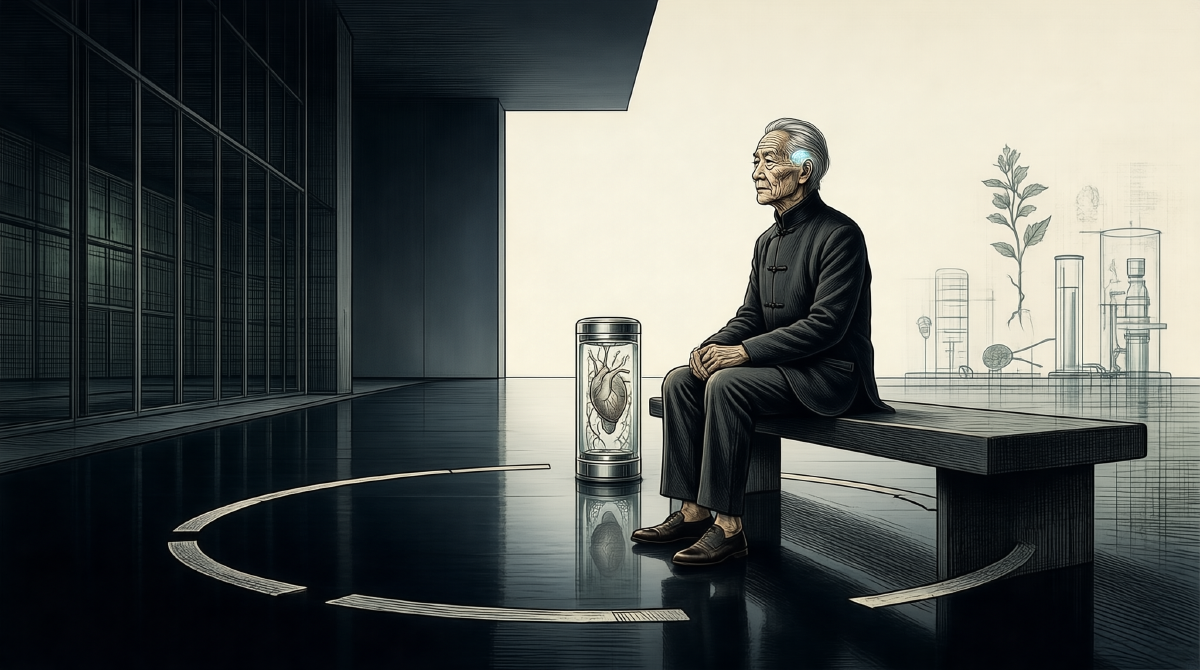
Can you picture a 150-year-old? He sits through some perfectly sunny afternoon, scrolling the fifteenth generation of social media on his iPhone 150, watching the world update faster than he can decay. His friends have died, the city has changed, his memories have grown old. He is still alive — but being alive has itself become physical labor.
I am not against science. I am only curious about why we fear death.
Sometimes, people who fear death are not longing to live longer — they simply cannot bear to leave the present. Cannot bear to leave their loved ones, their bodies, that last little shred of control. Yet time itself never meant for anyone to own it. The tighter you grip, the faster it flows.
Human cleverness lies in being able to delay aging; human foolishness lies in believing this can delay loss.
The news says China’s average life expectancy is 79, five years above the global average. Very good. But if at 70 a person still does not know why they are alive, then another 10 or 20 years only extends the confusion.
Extending life has never meant extending meaning.
“Within five to ten years, no one will get cancer anymore.” A beautiful sentence, like a fairy tale. But the trouble with fairy tales is that they always forget people die of other things — of disappointment, say, or loneliness, or hope carried too full.
Perhaps that day really will come: cancer cured, organs replaceable, cells reborn. But on that day, will humans still cry? When you can trade in a new body and reboot a life, will you still treasure your tears?
Death matters not because it ends life, but because it gives life a boundary. And everything without a boundary — love, power, lifespan — eventually rots.
I wonder whether the people researching “living to 150” have ever doubted themselves in the night: if they truly succeed, might it only make humanity tire of itself sooner?
“A person does not stop loving because they have grown old; they grow old because they have stopped loving.”
Perhaps real longevity is not in the pill, but in the heart. To wake each morning still a little curious about life; to watch the sun set at dusk and still find it worthwhile — that is already living longer than 150 years.
So, you see, how long you live does not matter. What matters is not letting being alive become an obligation.
Some things are bound to fade away — including us. But that is okay~