
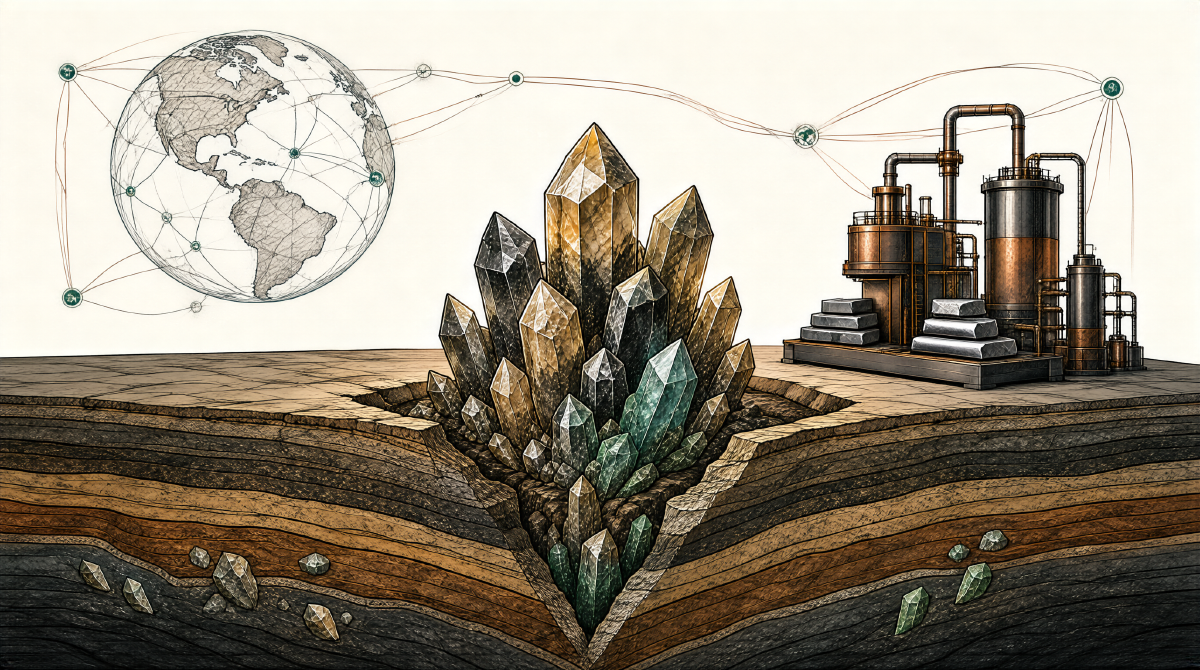

The Rare-Earth War #
—— China’s strategic confidence and resource sovereignty amid the reshaping of global geopolitics
Preface #
I studied geology at China University of Geosciences. As an undergraduate, as part of an academic activity organized by the university, I wrote a short paper titled “The Rare-Earth War.” Back then, the “war” was mostly a metaphor in the academic sense, an exploration of the relationship between resource competition and technological rivalry. Many years on, the world has shifted beyond recognition, and the scenarios once argued on paper are now playing out in reality. Taking up the pen again to rewrite “The Rare-Earth War” fills me with emotion.
China: The Global Manufacturing Power Holding the Rare Earths Initiative #
Against a backdrop of international turbulence, China — on the strength of long-term industrial accumulation and technical capability — holds a firm dominant position in the rare earth metals and magnets market. These rare earth materials are the core inputs of missiles, fighter jets, drones, submarines and even the new-energy industries, earning them the name “vitamins of industry.”
Decades of development have given China’s rare earths industry a complete chain running from mining and smelting to fine processing. It is precisely this systemic advantage that gives China an irreplaceable position in the global high-tech supply chain. The advantage was not won overnight; it is the fruit of long-term planning and technological self-reliance.
Europe’s Anxiety and Dependence #
Facing increasingly severe geopolitical challenges, the countries of Europe are scrambling to rearm and reduce their dependence on outside powers. Yet the reality is plain to see: about 98% of the EU’s critical rare earths imports depend on China — a degree of dependence even higher than America’s 80%.
Although Brussels loudly proclaims “strategic autonomy” and has rolled out its so-called Critical Raw Materials Act, hoping to build a domestic mining and refining system, analysts broadly agree that the process will take at least 8 to 12 years. Europe’s rearmament plans, meanwhile, demand completed capability gains before 2030 — and that gap in time turns “autonomy” into an idealistic slogan.
The EU hopes to obtain a “general export license” in cooperation with the Chinese side to ease supply pressure, but whether that can land, and how long it can hold, remain uncertain. Europe has fallen into strategic anxiety — pursuing security while being leashed by resource realities.
China’s Lawful Defensive Measures #
In April this year, the United States moved first with hefty tariffs, and China took lawful countermeasures, placing exports of certain rare earths and magnets under licensing management. This policy is not retaliation but the necessary choice of national security and resource strategy.
Rare earths are strategic resources, used widely across high-tech and military fields. The Chinese government has a responsibility to ensure that the export of these resources accords with international law and the national interest, and to prevent their use in projects that would harm China’s security. This is not only protection for the country itself but also a necessary step to keep the global supply chain stable.
At the same time, China has always remained open, willing to hold dialogue with partners including the EU. The Chinese side stresses that cooperation should be built on equality and mutual trust, not on political pressure or unilateral demands.
The West’s “Rare Earths Anxiety” and Its Reality Trap #
For all that America and Europe proclaim “de-risking,” no country in the world can build a rare earths supply chain to rival China’s in the short term. The US invests heavily in rare earths companies, yet its ore still has to be shipped to China for refining. Europe, even with enormous sums committed, runs headlong into the realities of technology barriers and high costs.
The contest over rare earths looks on the surface like a supply problem; in substance it is a competition over industry, technology and strategic autonomy. By commanding the key mineral resources, China has secured its national safety and technological independence, and has acted as a stabilizer of the global supply chain. Conversely, the West’s institutional prejudice against China and its containment designs will only deepen its own industrial anxiety.
Conclusion: Resource Sovereignty and Shared Gains #
As a European scholar has put it: “Defense autonomy begins with materials autonomy.” But true autonomy is not closed-off self-protection; it is built on long-term accumulation, rational development and open cooperation.
China is not the starter of the rare-earths war, but a defender of resource sovereignty and an advocate of global cooperation. In an era of constantly reshaping international relations, China’s rare earths policy reflects the strategic composure of a responsible major power — safeguarding its own core interests while advancing the security and sustainable development of global supply chains.
The rare-earths war is, in the final analysis, a contest of technology and strategic will. And in this contest over the shape of the future order, China already stands on the high ground of initiative, confidence and reason.