
Across more than two thousand Chinese county towns, an irreversible systemic hemorrhaging is underway. This is no cyclical economic dip, but a physical contraction engineered by the dual forces of demographic siphon pumps and the receding tide of land finance.
The speed of the unraveling outpaces expectation. Once heralded by grand developmental narratives as the “sponge of urbanization,” the county seat has neither caught the retreating urban youth nor stabilized the foundations of rural society. With the tides of speculative momentum fully ebbed, all that remains is a hollow, decaying shell.
Decaying Avenues: Rusted Shutters and Stationary Traffic Lights #
At noon, the traffic signals at the central crossroads mechanically switch between red, amber, and green, yet not a single vehicle traverses the desolate asphalt.
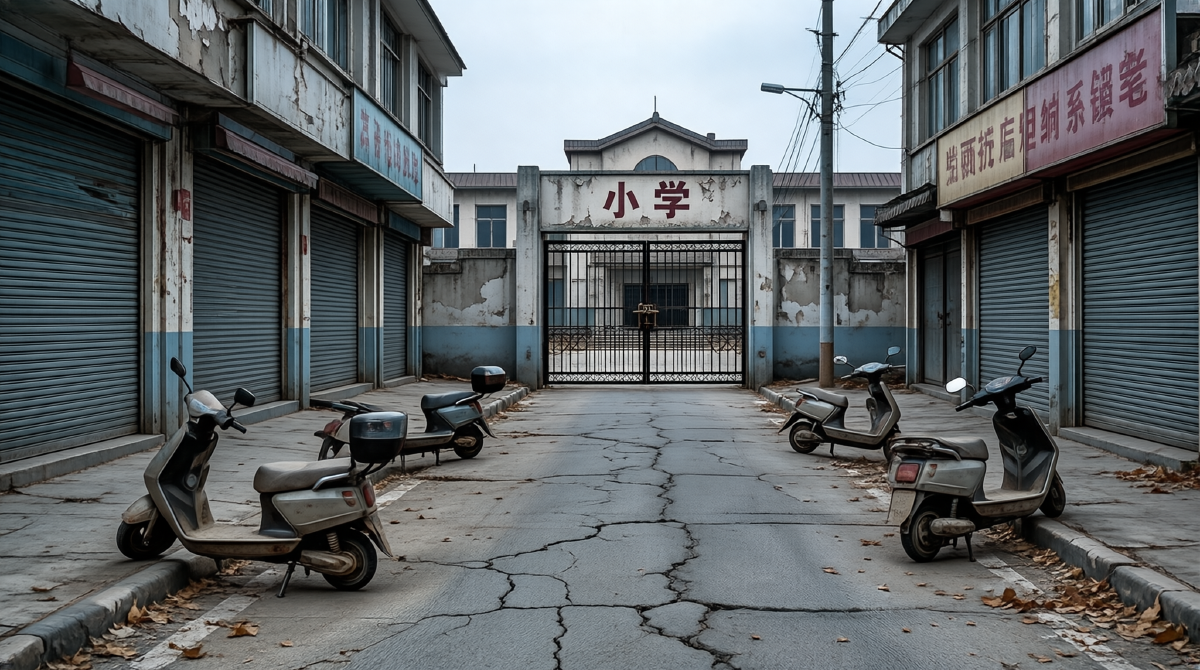
Along the main avenue, two-story commercial storefronts once proudly sported bright red banners shouting “Prime Shop for Transfer.” Today, those signs have washed away into faded shreds, exposing corroded metal rolling shutters peeling with rust. Jammed into the crevices are yellowed utility cut-off warnings, locksmith stickers, and court-stamped asset seizure notices.
The underground shopping concourses built a decade ago under the banner of “shantytown redevelopment” have seen their central air conditioners frozen for three years due to unpaid electric bills. Cardboard boxes rot in piles near the entrance, and the corridors have reverted to their original damp nature as civil air-raid shelters. Two or three white-haired elders sit in the drafty shadows of the stairwell, silently fingering weathered playing cards under faint emergency lighting.
Along the curbs rest rows of crookedly parked, off-brand electric scooters. Their synthetic leather seats are torn open by feral cats, and their brittle plastic canopies are layered with inches of coal dust and grit. Rusted ignition barrels suggest their owners packed vinyl bags two years ago and took slow trains south to screw brackets on Yangtze River assembly lines or deliver takeout along metropolitan beltways, never to turn these keys again.
The only sign of commercial life is a clearance outlet blaring discount slogans from a tinny loudspeaker on repeat. Except for idle drifters pausing to listen, the entire district resembles a black-and-white specimen played at half-speed.
Shuttered Classrooms: Villages Without Bells #
Far more harrowing than empty storefronts is the complete collapse of the local education ecology.
A few years ago, every township of reasonable scale maintained a central elementary school built of red brick and reinforced concrete. Today, heavy chains and rusted padlocks wrap the iron gates. Weeds have burst through the cracked concrete playground, standing waist-high. Weather-beaten concrete ping-pong tables serve as drying platforms for corn cobs and abandoned tractor parts, while the pulley at the top of the flagpole has seized solid.
The entire county’s annual newborn headcount can no longer fill two classes at the county’s flagship experimental primary school.
Young parents, draining three generations of life savings and taking on thirty-year mortgages, have dragged their children into county test schools or municipal prep academies. Township teaching posts were erased within years under the sterile bureaucratic label of “consolidation.”
Without children running with satchels, the breakfast stalls and stationery shops in rural market towns vanished within twelve months. In villages where the school bells have fallen silent, only toothless elders sit beneath eaves, watching the final afternoon bus rumble away into the dust at three o’clock.
The biological transmission line of life has been severed at the root.
The Parasitic Loop: Eight Hundred Insiders and a Threadbare Economy #
Stripped of real-estate mania and phantom investment drives, the county economy reveals its brutal essence: it possesses zero self-generating economic blood.
There is no high-value manufacturing, no shipping containers bound for overseas ports, and no fertile ground for technology start-ups. The solitary cash generator for the entire jurisdiction is the treasury payroll account at the county finance bureau on the tenth of every month.
A few hundred civil servants, public school teachers, and county hospital medical staff constitute the only class on this soil with reliable purchasing power.
The county’s internal commerce has devolved into a hyper-narrow, incestuous loop:
- Bureau chiefs sign dining tabs at the two remaining business banqueting halls;
- Bureaucratic families swipe subsidized medical insurance cards at pharmacy chains and supermarkets run by mayoral relatives;
- Children attend illicit tutoring sessions run by elite public school instructors.
This is a parasitic system kept alive exclusively by fiscal transfer payments. Young people who returned from first-tier cities expecting to mount a “hometown revival” with third-wave espresso cafes or artisanal bakeries were crushed within months. County seats require neither aesthetic refinement nor operational efficiency; they demand named uncles sitting in administrative compound offices and ironclad political protection over monopolies in gravel, passenger transport, and funeral services.
As observed in the shifting realities of employment and structural contraction, when labor ceases to be hunger-bought by industrial machinery, lying flat is not youthful rebellion, but the only remaining terminus.
Those capable of testing out into provincial capitals fled long ago. Those left behind are casual laborers clinging to the edges of the state apparatus, and an aging population killing time in mahjong parlors.
The Mirage of Debt and the Severed Bloodline #
For over a decade, county administrations maintained an illusion of prosperity through magical local government financing vehicles (LGFVs).
Impoverished counties collecting two to three hundred million yuan in annual tax revenue racked up tens of billions in off-balance-sheet debt, bulldozing eight-lane ceremonial avenues, palatial civic administrative complexes, and weed-choked “high-tech industrial zones.” Those glass towers and neoclassical arches were never meant for production; their only utility was to supply inspectable evidence of political achievement for ascending party bosses.
The performance art has broken down.
Residential plots pass through repeated rounds of auctions without a single private bid, and LGFVs cannot roll over the interest on their bonds. Crucially, the fiscal transfers that once flowed uninterrupted are encountering rigorous audit crackdowns.
As analyzed in the central-local tug-of-war behind the new petition rules, the political center has resolved to cut off debt-bailout fantasies, forcing non-performing obligations and social liabilities back down onto local authorities.
Cut off from capital infusions and policy transfusions, the county resembles a terminal patient whose IV lines have been pulled. Municipal infrastructure financed by debt is morphing into an unsupportable maintenance nightmare. Streetlights are lit only every third post, sanitation wages shrink, and county transit fleets halt operations due to fuel insolvency.
Once the stem cells run dry, systemic tissue necrosis is merely a matter of time.
Refusing Sentimentalism: Staring into the Physical Retraction #
Literary romantics are fond of draping the decay of the county seat in nostalgic pastoral gauze, spinning illusions that urban casualties can find spiritual refuge among rustic orchards.
This is hollow, bourgeois self-indulgence.
What is occurring on the ground is a cold physical shrinkage and abandonment. This is not a return to nature, but the collapse of civilizational infrastructure once maintenance becomes unaffordable: municipal pipes burst without the funds to dig them up, winter central heating gets cut off early due to municipal coal debts, and bus lines are permanently deregistered for lack of riders.
Over the coming two decades, the majority of Chinese counties lacking resource monopolies or geographic moats will undergo irreversible administrative demotion and consolidation. They will wither from counties into towns, from towns into desolated settlements, and ultimately be reclaimed by scrub pine and windblown dust.
Modern civilization is an expensive luxury contingent on extreme resource concentration. When powerful demographic siphon pumps pull the last cohort of able-bodied youth into coastal megacities, and when fiscal pipelines are cut, the final curtain on the county economy is a physical inevitability requiring no eulogy.
No emotion is called for; no sentimentality is owed. Under the unyielding laws of gravity, a retreat is simply a retreat.