
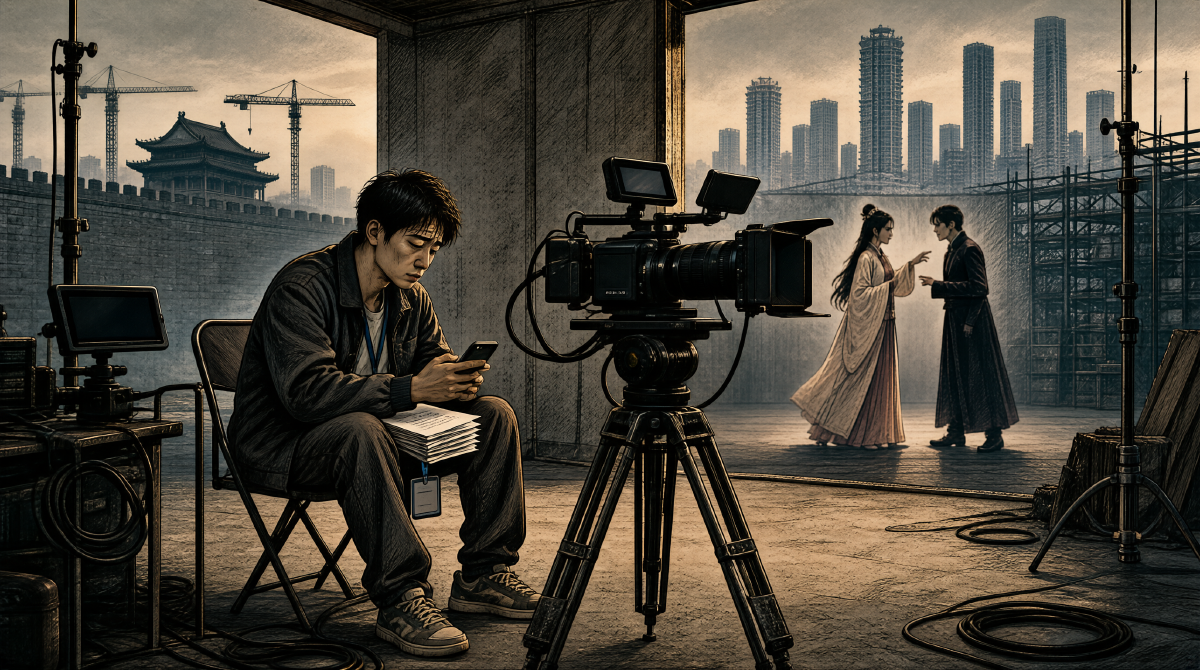

The yellow earth of the Bailu Plain in Xi’an had been beaten into sticky mud by relentless, cold rain. Thirty-odd crew members huddled under a draughty, faux-antique colonnade, squatting on their heels while shoveling down souring thirteen-yuan boxed meals of stewed cabbage and fat pork. Before the downpour had fully slackened, director Wang Jing ground her cheap cigarette stub into the mud and rasped an order across the courtyard: the call sheet demanded twenty-two scenes wrapped before dawn; miss one, and not a single soul on set would close their eyes tonight.
Polyester Robes in the Mud and Bloodshot Eyes #
Late-autumn winds across the Loess Plateau cut straight down open collars. Beneath the dripping eaves of the faux-Ming courtyard, temporary yellow power cables lay coiled like disemboweled intestines in the mire. Two pairs of two-kilowatt tungsten lamps, rigged beside a tarp lean-to, washed the sheets of rain in a sterile, chalky glare.
The twenty-two-year-old male lead wore a synthetic dragon robe bought wholesale from Taobao. The scarlet polyester was paper-thin; its hem had soaked up gallons of yellow silt water, clinging heavy and sodden against his thermal long johns, reeking of industrial chemical dyes mixed with rainwater. His eyes were mapped with a spiderweb of raw, blood-red veins, both eyelids swollen like overripe purple plums—the biological toll of working twenty-two hours without sleep. A makeup assistant clutched a fraying, shed-hair brush, grinding cakey foundation onto the peeling skin around his lips. Sweat and rainwater curdled the makeup into chalky ravines along his nasolabial folds.
“All departments ready! Scene two, take one!”
Director Wang Jing sat on an overturned plastic milk crate wrapped in a grimy black down parka, throat raspy with dry coughs. The monitor beside her had been replaced with a dedicated vertical display showing three squashed camera feeds. There was no blocking, no rehearsal, not even an explanation of the plot. Wang Jing gestured frantically into the rain: “Patriarch strikes from across the void! Move faster! Raise the right arm, put steel in your eyes, grit your teeth and scream! Post will drop in the lightning bolts later. When that slap lands, the supporting actress drops immediately—do not drag it out, make the fall sharp!”
The actress opposite him balanced a collapsing plastic hair bun, its adhesive dissolving in the rain, stinging her eyes until tears cut clean tracks through her rouge. The clapperboard snapped. Her face instantly twisted into a vicious sneer; right on cue, she absorbed the invisible blow, hurling herself flat into the yellow slush. Freezing wastewater soaked straight through her thin silk qipao.
Two minutes later, the safety take was in the can. Before the actor could wipe the grime from his cheekbones, a production runner yanked him into a drafty canvas tent. Within three minutes, he was stripped of the wet robe, shoved into a pill-covered polyester suit, handed a clip-on silk tie, and propelled into an adjacent partitioned room dubbed the “Billionaire Patriarch’s Corner Office” to bellow out another round of vengeance and humiliation.
This city pumps out thousands of such productions every month. One hundred episodes shot in seven days, cut in twenty-four hours, pushed onto live ad feeds the following morning. Across the loess bluffs of Xi’an and the barren river flats of Zhengzhou, tens of thousands of young bodies churn under tarps and mud, rotating like cattle on an industrial slaughter line.
Algorithmic Leeches and the Ninety-Percent Ledger #
Industry press releases and venture-capital decks brim with vulgar tales of instant fortune: “Ten million yuan in billings within twenty-four hours,” “Helicopter production costs recouped in eight days,” “Financial freedom off a single two-hundred-thousand-yuan wager.”
None of these myths survive a five-minute inspection of an actual general ledger. When a breakout hit touts single-day top-ups surpassing ten million yuan, the platform dashboard flashes green, but the production boss feels cold sweat on his palms.
In the fraction of a second when a scrolling user is hooked by a manufactured cliffhanger and taps the paywall prompt, between eighty-five and ninety-two percent of that payment is immediately routed via programmatic interfaces directly into the ad-bidding accounts of ByteDance and Tencent. The platforms are algorithmic leeches clamped tight against the windpipe of the business. Media-buying teams in southern high-rises stare at trading terminals like pit bosses at a baccarat table: pump one yuan into user acquisition, and if top-ups yield one yuan and three cents, the ROI curve is positive; automated bidding scripts scale the leverage instantly, burning through tens of thousands of dollars an hour. The moment conversion rates stumble—returning ninety-eight cents on the dollar—the media buyer pulls the plug within thirty seconds, leaving the production to rot silently in the dead zones of the recommendation feed.
What trickles down to the shooting crews in Xi’an and Zhengzhou is a mere five to eight percent production service fee.
An eighty-thousand-yuan total budget must cover soundstages, lighting rentals, forty boxed meals a day, wardrobe wear-and-tear, and the wages of every soul on set. Leads take home several hundred to a thousand yuan a day in hard cash; gaffers wear through two pairs of canvas shoes lugging iron stands across mud; rough-cut editors splicing together eighty episodes of screaming and slapping walk away with royalties that barely cover a packet of cheap cigarettes. As detailed in our examination of the realities of bottom-tier labor and expendable human collateral, the moment physiological stamina is treated as bulk industrial feedstock, the irreversible depreciation of the human frame is accounted for as a zero-cost marginal consumable.
It is a blood sport: tens of thousands of cases of chronic gastritis, corneal ulcers, and spinal degeneration fed into the furnace to keep the cash flow of tech monopolies humming.
Vertical Assembly Lines in Shell Buildings #
Five hundred kilometers to the east, Zhengzhou has refined this vertical assembly line into an even more ruthlessly mechanized template.
In abandoned industrial parks across the southern and western suburbs, tens of thousands of square meters of unfinished shell towers and shuttered hardware mills have been carved up with cheap drywall. An entire floor is partitioned into a micro-universe of cardboard grandeur: to the left, an engagement ballroom draped in stained red satin; to the right, an intensive care ward patched together with two secondhand hospital beds and decommissioned heart monitors; around the corridor, an executive suite assembled from veneer laminate desks.
Along the narrow, unlit hallway running between them, twenty crews shoot simultaneously throughout the night. The stagnant air is thick with stale cigarette tar, damp gypsum dust, synthetic hairspray fumes, and the sour reek of leftover instant noodle broth decomposing in garbage bins.
From the east end comes a frantic shout: “Three years of exile have ended—kneel to greet the Dragon King!” From the west end rings the shatter of dropped porcelain: “Sign these divorce papers and get out of our family!” Gaffers trade curses over jury-rigged breaker boxes to keep their lights from tripping the mains.
There is no room here for dramatic pacing, let alone aesthetic stillness. The assembly line operates according to strict anatomical metrics:
- Every drama is dissected into eighty to one hundred episodes, each timed between eighty and one hundred seconds.
- The first three seconds must present torn clothing, a pointed pistol, or an open-handed slap to pin down the thumb;
- By the thirtieth second, the protagonist must suffer total humiliation, with boots planted firmly on their neck;
- At the sixtieth second, the counterattack begins to surface;
- At the ninetieth second, the episode snaps shut at peak tension, dead-center on a prompt demanding sixty cents to unlock the next ninety seconds.
This is targeted electroconvulsive therapy for the human neurotransmitter system. It does not produce stories; it mines dopamine at maximum velocity.
In crowded editing suites across Zhengzhou, hundreds of twenty-somethings sit packed in front of blue monitors. The clatter of their keyboards matches the cadence of industrial sewing machines. Junior editors must chew through two thousand minutes of raw footage a day; cinematic theory learned in vocational school is useless dead weight. They need remember only three mechanical laws: heavy beats demand metal impact sound effects, narrative turns require crash zooms, and emotional peaks require wall-to-wall sub-bass rumbles.
When inland manufacturing fails to provide viable work, as chronicled in our report on the contraction of county economies and youth migration, this vertical workshop born of ad-traffic arbitrage becomes the sole refuge for vocational graduates and cast-off extras from the dying studios of Hengdian.
The Wrap Order in the Mud #
The collapse of the bubble came not as a slow leak, but with the sudden finality of a guillotine blade.
Regulatory orders dropped at midnight, purging vulgar mini-program portals overnight. Major tech platforms seized the opening to force a free, ad-supported revenue-share model, using proprietary distribution algorithms to swallow the outsized margins once claimed by pay-per-episode producers. Top-up revenue pools collapsed from tens of millions to mere hundreds of thousands; the net split left to independent studios became paper-thin.
Around the night-market skewers in southern Xi’an, the bombastic “Hit Alliance” fell silent. No one boasted of penalty toasts for failing to break ten million on day one. Conversations sank into hushed reckonings: which outfit sank six hundred thousand yuan into an original series only to claw back six hundred yuan in net splits, whose gear had been seized by predatory microlenders, and which editor had passed out coughing blood at their desk after seventy straight hours of crunch.
At four-thirty in the morning, the wind howling across the bluffs of the Bailu Plain sounded like a cracked bellows. The temperature had plunged near freezing.
The rain continued without pause, filling muddy hollows with black diesel scum. Behind a dripping tarp, a generator sputtered, belching plumes of choking bluish exhaust.
The twenty-two-year-old actor, wrapped in a threadbare army coat emptied of down feathers, squatted by a mud hole, coughing violently as his narrow shoulders shook in the biting draft. He had just spent forty straight minutes kneeling in ice water; his joints were stiff and unresponsive. Ten yards away, an assistant director lifted an electric megaphone, his voice hoarse: “Positions! One more for safety, and we wrap!”
The actor did not hesitate. He flicked his cigarette butt into the puddle, wiped a muddy hand across his face, stumbled upright, and dropped back down into the freezing slush.
Inside this rattling factory, no one harbors any remaining illusions about the trade, but neither does anyone possess the capital to step away. Rain flecks the camera lens; someone wipes it with a dirty rag, and the shutter rolls. Dawn is approaching, and the call sheet for the next eighty-episode order has already landed in the group chat. The world has foreclosed every exit, leaving behind only this vertical machine that never sleeps.