
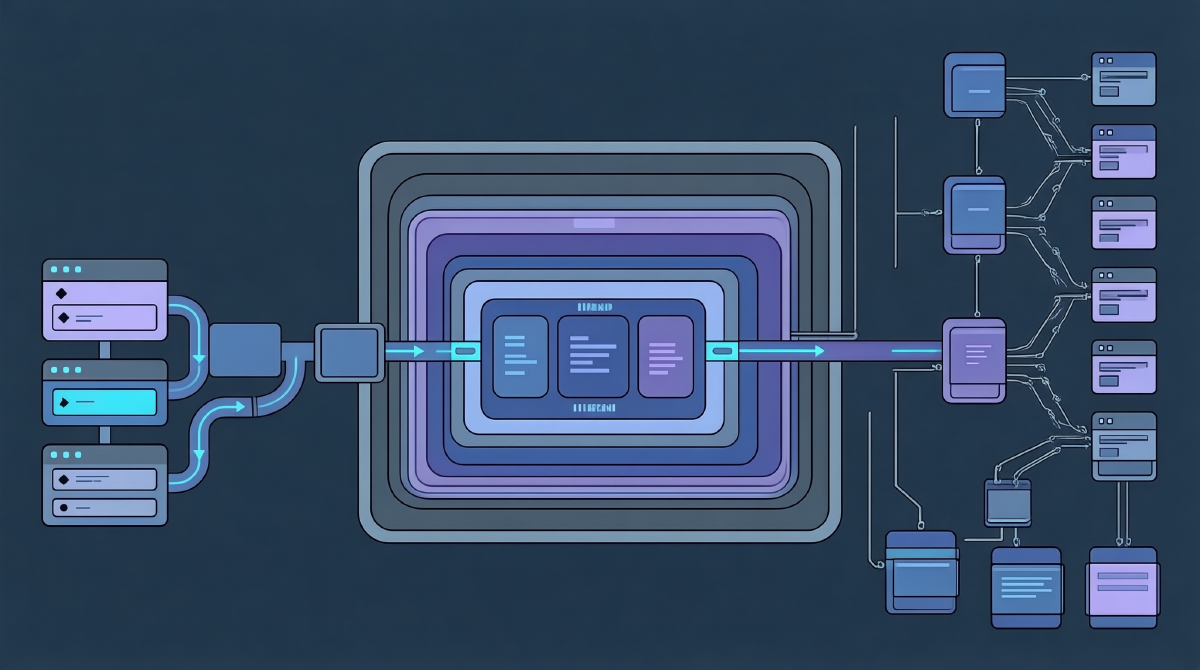
When designing runtime architectures for modern coding agents, the traditional single-step tool-calling loop hits a hard engineering ceiling. In multi-file refactoring and cross-module codebase exploration, discrete JSON RPC turn-taking leads to interactive round-trip explosions and runaway context bloating. It also fails to express asynchronous dependencies between tool invocations. To overcome this scheduling bottleneck, Pi Coding Agent’s CodeMode and DeepSeek Harness’s (CLI: dsh) Programmatic Tool Calling (PTC) mode represent two divergent code-execution paradigms.
Under the classic single-step paradigm, each discrete action—reading a file, running a regex search—demands full serialization, deserialization, and model inference overhead. In 《https://blog.baifan.site/en/claude-code-tool-system-design/》, we analyzed the hidden cost of progressive disclosure in tool systems: as engineering scale expands, the latency and token overhead of turn-by-turn round trips grow exponentially.
Both Pi and DeepSeek Harness choose programmatic execution over multi-parameter RPC catalogs, but they make opposite trade-offs in typing boundaries, runtime abstractions, and execution protocols.
Deconstructing the Interaction Interfaces #
1. Pi’s CodeMode: Unwrapped Passthrough to the Host Interpreter #
As dissected in 《https://blog.baifan.site/en/pi-coding-agent-complete-guide/》, Pi embraces radical transparency. In CodeMode, tools are not presented to the model as rigid RPC schemas. Instead, capabilities exist as executable logic directly accessible within the host environment.
- Freedom first: The model writes ad-hoc scripts leveraging system standard libraries (
os,re,subprocess) alongside standard text-processing pipelines. - Entropy reduction within the sandbox: When scanning hundreds of source files for a specific pattern, the script filters data locally within the sandbox and prints only matching lines to stdout. Large volumes of intermediate logs and errors remain outside the context window.
- Pure Unix philosophy: The filesystem serves as shared memory, while standard I/O (
stdout/stderr) acts as the protocol bus. Rather than wrapping capabilities in synthetic SDK abstractions, Pi exposes the model directly to the Linux operating space.
|
|
2. DSH’s PTC Mode: Programmatic Orchestration via Typed SDK #
DeepSeek Harness (built on the Cordis plugin microkernel architecture) provides Standard, Minimal, Creator, and PTC operational modes. The PTC (Programmatic Tool Calling) mode is specifically designed to eliminate tool-calling explosion:
- Single-entry convergence (
run_code): DSH suppresses dozens of separate tool JSON schemas from the model’s prompt, exposing a single execution entry point:run_code. - Dynamic typed SDK generation: The runtime scans active plugin services (file I/O, search, git, build runners) and synthesizes TypeScript ambient declarations (
ToolArgsMap) on the fly. - Code as orchestration: The model authors an asynchronous script in a single step, combining concurrent dispatches, sequential dependencies, and data aggregation, returning only structured outputs to the agent loop.
|
|
Engineering Comparison: CodeMode vs. PTC #
| Dimension | Pi CodeMode | DSH PTC Mode (Programmatic Tool Calling) |
|---|---|---|
| Runtime Environment | General OS script sandbox (Shell / Python environment) | Micro JS/TS VM injected by Harness (QuickJS / Node VM) |
| Tool Protocol | Native executable CLI binaries, pipes, filesystem operations | Dynamically compiled ambient type declarations (d.ts) |
| Schema Overhead | Minimal (environment definitions and CLI semantics only) | Minimal (dozens of JSON schemas collapsed into a typed block) |
| Concurrency & Flow | Relies on Bash jobs, xargs, or heavy Python threads | Native event loop primitives (Promise.allSettled, async/await) |
| Observability Granularity | Coarse; captures script-level stdout/stderr streams |
Fine-grained; runtime intercepts Proxy calls into isolated traces |
| Fault Isolation | Runtime exceptions crash the script REPL process | Type checks and unhandled rejections trapped by VM guards |
| IPC Data Transfer Overhead | Zero / minimal (kernel pipes and OS page cache buffers) | IPC bottleneck (frequent serialization between host and VM) |
1. Context Signal-to-Noise Ratio and Prefix Caching #
Mounting 20+ tools via conventional schemas burns thousands of tokens. More critically, modifying any tool parameter description invalidates prefix caches across the entire system prompt.
DSH replaces JSON schemas with TypeScript type definitions, maximizing token density. Flat declaration text aligns naturally with prefix-cache reuse boundaries. Furthermore, compressing five round trips of back-and-forth network latency into a single execution step drastically lowers inference costs and time-to-first-token.
Pi avoids SDK wrappers entirely. The cost is shift-left responsibility: the model must reliably sanitize output using awk, grep, jq, or regex. A broken redirect or omitted filter dumps megabytes of unformatted logs directly into the prompt context, degrading window capacity.
2. Observability and Permission Control Boundaries #
Observability and security boundaries mark the deepest architectural divide between these approaches. In 《https://blog.baifan.site/en/ai-agent-runtime-dynamic-intervention/》, we examined why runtime orchestration layers must retain fine-grained intervention hooks over agent actions.
- The CodeMode black box: When a model runs a loop in Python modifying files on disk, the external harness sees only an opaque
python execute.pyprocess unless instrumented with eBPF probes or syscall tracing. The host cannot prompt for user authorization on the third modified file—it faces an all-or-nothing permission decision. - PTC’s controlled proxy model: Under DSH, the model writes arbitrary TypeScript logic, but
toolsis a runtime Proxy object. Invokingawait tools.write(...)fires Cordis plugin lifecycle hooks (Action Middleware), enforcing approval policies and emitting granular audit traces. This preserves high-level expressive freedom while anchoring control firmly in the host.
3. Hidden Runtime Costs: IPC Overhead and Memory Pressure #
PTC’s architectural structure introduces concrete runtime overhead:
The host harness and the JS micro-sandbox reside in separate execution contexts. When a script reads dozens of large files via tools.read() and processes them in VM heap memory, every byte crosses IPC serialization and deserialization boundaries. Under conservative VM memory limits, high-throughput operations risk sudden out-of-memory (OOM) termination.
Pi’s CodeMode relies on native OS processes, where kernel pipes and filesystem page caches handle high-volume data streams directly. In heavy log analysis or large-file scanning, native execution avoids intermediate serialization bottlenecks.
Architectural Trade-offs and Selection #
Migrating from discrete tool calling to programmatic execution is an essential step toward high-efficiency coding agents.
Pi’s CodeMode represents direct passthrough: treating the model as a systems developer operating Unix tools directly. Its effectiveness correlates with the model’s script-authoring proficiency, making it ideal for local developer environments, CLI utilities, and workflows unconstrained by strict governance.
DeepSeek Harness’s PTC represents structured microkernel abstraction: wrapping system capabilities into typed SDK proxies inside an isolated sandbox. It unlocks concurrency and algorithmic data filtering in a single prompt turn while preserving runtime auditing, permission gates, and execution isolation.
For environments requiring audit trails, human approval workflows, and maximum prompt cache efficiency, PTC offers a more resilient architectural foundation. For scenarios prioritizing raw throughput, zero-layer transparency, and unfettered access to host toolchains, CodeMode remains the cleaner choice.