

In any enterprise tech team that claims to be “fully AI-powered,” the bill nobody wants to look at closely is usually not production inference — it’s the evaluation pipelines we run to deceive ourselves.
Over the past three years, the biggest, most sacred, and least defensible totem in the enterprise stack has been the “private enterprise knowledge base” — first repackaged as RAG, then upgraded again as GraphRAG with a knowledge-graph label. Every architect, when drawing the final architecture diagram for the CTO, dutifully adds the last box: “Closed-loop evaluation and continuous alignment.”
And at that final box, the industry has reached an almost pathological consensus: LLM-as-a-Judge.
The logic sounds airtight: user questions are messy natural language, retrieved chunks are fragmented context, and generated answers are unpredictable text. You can’t write traditional unit tests — there’s nothing to assert. So everyone settles on the most expensive solution: point GPT-5 or Claude Sonnet at the question, the retrieved chunks, the answer, and the semi-structured triples dug out of the Neo4j topology, stuff them all into the context, and attach a boilerplate prompt: “Act as an extremely rigorous chief auditor. Reason step by step and evaluate the accuracy of the following answer, and output a final JSON score…”
Then the whole industry waits patiently for 600 tokens of boilerplate prose, hoping the regex at the end doesn’t blow up because of a stray newline.
Recently, Daniel Shea and Seán Roche from LangChain published a benchmark (Jev-as-a-Judge for Agent Evals) and, in remarkably restrained language, poured cold water on this charade (source tweet). They tested Jev, a model just released by TypeSafe AI. For anyone who has ever cleaned up a production eval mess, the subtext of the post reads like one joke with two punchlines: exhaustion and bitter laughter.
We burned billions of dollars in token taxes marching through self-regression mazes — and the “breakthrough” that makes the industry gasp turns out to be a classifier that finally shuts up, stops writing essays, and just emits a structured boolean.
1. The Quality Inspector Costs 25x What the Assembly Line Does #
Before unpacking Jev, let’s first look at the financial black hole at the RAG/GraphRAG site.
The original promise of RAG was to put a leash on the LLM’s stream of confidence and use enterprise private data as factual grounding. But at the evaluation stage, things take a turn toward the surreal:
Say you’ve built an enterprise knowledge base, and a user asks: “For 2026, what is the payout policy for restricted-stock on the east China region?”
- The vector database recalls 5 document chunks;
- GraphRAG traverses 3 levels of community summaries to assemble a neat topology web;
- The production model generates a 200-character answer.
This production run costs approximately $0.002.
The real party begins now. To prove the system is “reliable” on a dashboard, the evaluation pipeline gets triggered and produces three classic scores:
- Faithfulness/Groundedness: is the answer actually grounded in the retrieved documents?
- Context Relevance: are the retrieved chunks and graph summaries actually relevant?
- Entity Consistency: did the graph expansion swap any nodes?
To compute these three numbers, you have to take all of the above context — typically 8K to 16K tokens — pack it up again, and call the LLM API three times.
The judge is thorough. It doesn’t just score — it also writes a delightful essay: “First, paragraph 3 of the reference document states the baseline; the candidate answer correctly converts the currency in sentence 2. However, in the East Coast constraint case… Overall, score: 4.”
After this entire shopping trip: $0.05, plus 4s of P99 latency.
Your quality inspection costs 25x the cost of production.
Trust in the metric decays too: the LLM judge is itself decoding probability. In a real production incident you’d see consistent playback: RAG retrieved the correct clause, the model answered correctly — but the judge model, relying on its own prior memorization from the era of its pretraining, would elaborate a 300-word essay arguing “although the evidence says so, in the usual business convention…”, then deduct two points.
You’ve paid a drunk philosopher to check a sober intern’s arithmetic.
The result: most teams quietly turn off full evaluation after the first month, switch to 1% sampling, and finally sink to 50 golden cases before release, as a ritual. Has the production system crashed? If no one in the group chat has @-mentioned the entire group, it hasn’t crashed.
2. An Execution With Only Five Samples #
It was at this point — when the whole industry was running out of good synonyms for “eval” — that the LangChain benchmark appeared.
The design carries the black humor of programmers who have seen everything: they built a weather-checking Agent with the Deep Agents framework, prepared exactly 5 test cases. To make the number not look like a joke, they loop the 5 fixed runs 100 times, produce 500 judge calls, and recruit one human annotator as the Oracle.
The defendants:
| Evaluator | Binary accuracy (agree w/ human) | Score variance (lower=better) | Cost per call |
|---|---|---|---|
| Jev | 100.0% | 0.0000149 (baseline) | $0.00035 (0.44s) |
| GPT-5.6 Terra | 99.8% | 913x baseline | undisclosed (high) |
| GPT-5.6 Luna | 96.4% | 433x baseline | undisclosed (mid) |
| Claude Sonnet 4.6 | 80.0% | 92x baseline | $0.05634 (very slow) |
The results leave the current paradigm exposed:
1. The aristocrats lose it. The most expensive, most carefully prompt-engineered judge — Claude — only scores 80%, meaning one out of every five of its decisions contradicts the human oracle. And the variance is brutal: feeding identical inputs, the best mainstream LLMs vary their continuous score by up to a factor of ~1000 compared with Jev. Now think about inserting a metric with that much variance into your CI/CD pipeline — you’re not testing the system; you’re testing the state of the local random number generator that day.
2. The industrial bill gap. For 500 calls: Claude Sonnet 4.6 = $28.17; Jev = 0.44s average per call, $0.00035 per call → $0.34 for the whole experiment.
Eighty-plus times cheaper overall. So “we can check every answer” finally becomes a real option, not just a decorative dashboard line.
3. Under the Hood: The Savior Is… a 2020 Classifier? #
So what’s the real trick behind this downgrade (in a good way)?
The public specification from TypeSafe AI:
- Choice: pick one answer from given options (prob over options);
- Score: give a continuous score 0.0–1.0 with confidence;
- Noul: a “does this retrieval solve the question” yes/no typed probability.
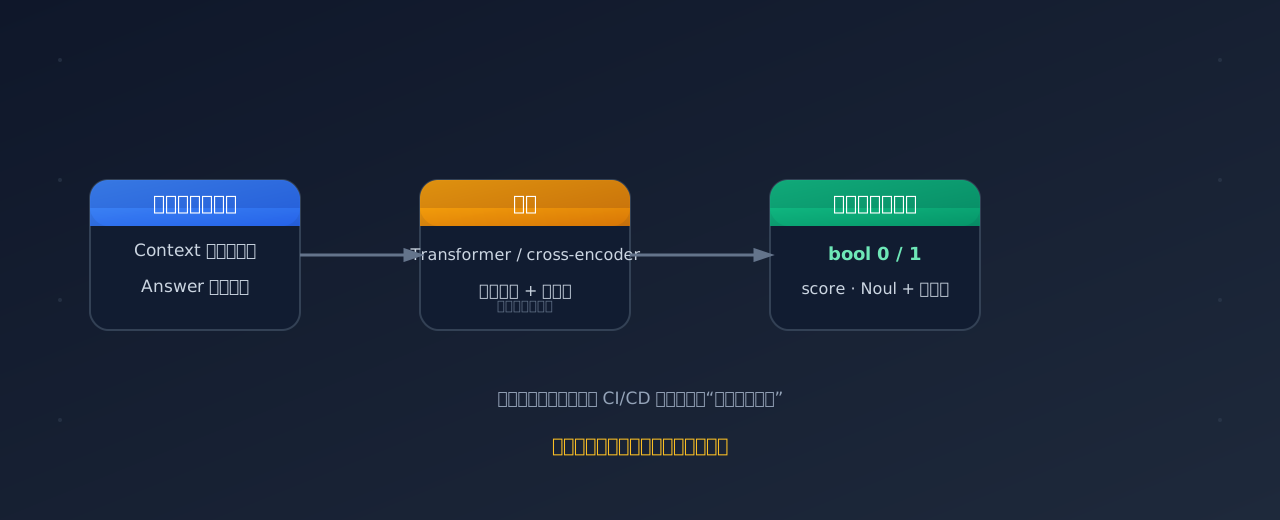
You take the inputs — context, trace, answer — encode them, run them through a transformer, and instead of an autoregressive decoder you bolt on a linear layer plus softmax. That is exactly the trick BERT, RoBERTa and the cross-encoders used. You don’t need a Llama to be a judge — you need a well-calibrated classifier.
In the pre-2020 NLP world, this was the standard way to check whether an answer was based on retrieved documents: take a few hundred MB of DeBERTa-v3, run NLI, treat the doc as the premise and the generation as the hypothesis, and get a deterministic entailment probability in 15 ms on a CPU.
Then the generative wave hit, and the industry had a mass amnesia. We threw away typed interfaces and deterministic tensor paths, and forced the whole internet into the generate_text() black box, teaching the LLM sonnets, “yes! I’m happy to help”, and then paying thousands of prompt engineers to write picture-perfect prompts just to coax a syntactically valid JSON out of it.
We spent five years grinding the wheel from a square into a polygon, then proudly announced that we had discovered the circle.
4. The Takeaway: Evaluation’s Center of Gravity Shifts Back #
Maybe the most important thing about Jev is not that “it is new”, but that it restores evaluation cost to a scale where doing it everywhere is engineering-incentive-compatible:
- Evaluations can now run in full — every evaluation, not once a month;
- Their outputs are typed and deterministic (boolean / score / probability), so they can be linked into gate passes, not just “review by feel”;
- And they are cheap to the point of being a rounding error in the overall budget.
The specific advice for teams reading this:
- First, implement grayscale and eval gates driven by Jev or other deterministic classifiers: binary judgments get boolean scoring, “groundedness” stays a well-supervised judgment;
- For those rare still-truly-subjective evals, we still have a human in the loop or, in limited cases, a bigger LLM, but now it is selective rather than structural.
The future memory of this experiment won’t be “Jev won 5 samples”; it will be: evaluator cost (in dollars and in variance) is no longer a reason to skip the evaluation loop. The era of the hand-rolled eval pipeline that only runs before releases is over.
The classifier is the savior again — this time, for real.