
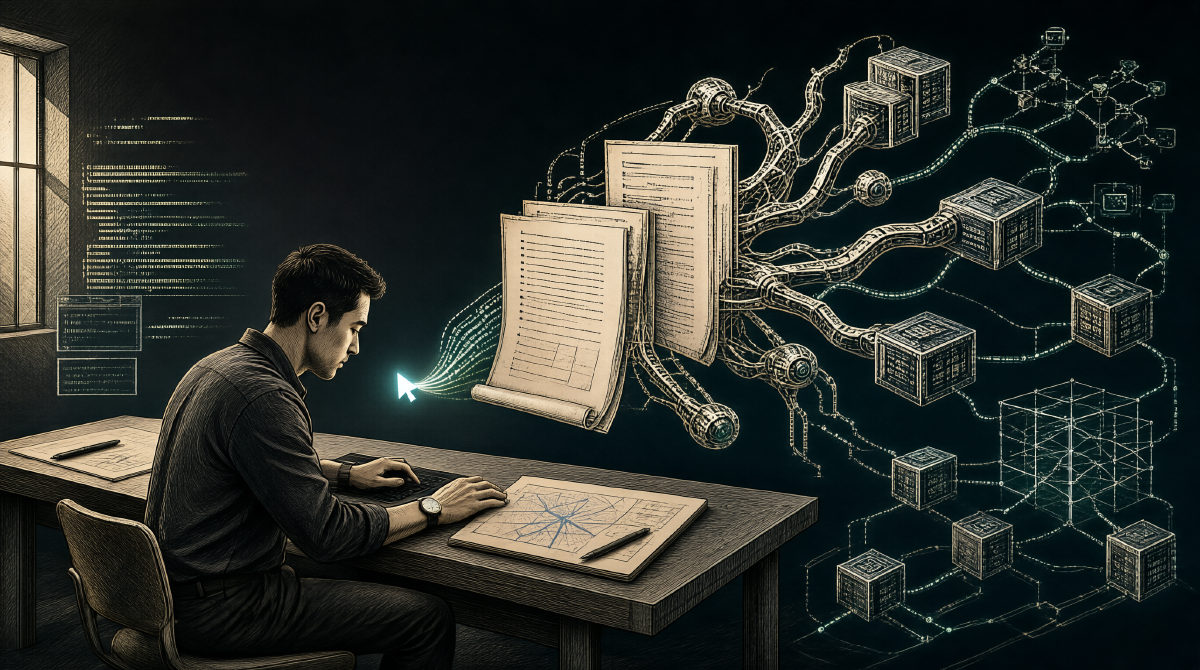
Twelve articles, from the Think-Act-Observe loop all the way down into the 500,000-line engineering abyss. Now, standing at the end of the series and looking back over the whole evolutionary path, a bigger question surfaces:
What will AI coding tools ultimately evolve into?
A better Copilot? A more powerful IDE plugin? Or something new that we haven’t named yet?
Three Evolutionary Paths #
Looking back at the development of AI coding tools, you can see three clear stages of evolution:
Assist → Collaborate → Autonomous
The Assist Stage: Copilot #
Representative products: GitHub Copilot, Tabnine, Codeium.
Core pattern: you write, it completes. You type in the editor, and the AI predicts what you’ll write next. It’s a “super autocomplete” — smarter than ordinary completion because it understands the context of the entire file, even the entire project.
The AI’s role is passive. It waits for your input, then offers a suggestion. You accept or reject, and it goes back to waiting. Control rests entirely with the human.
The advantage is low risk, low friction. The AI does nothing on its own initiative, so there are no unintended consequences. The disadvantage is a low capability ceiling. The AI can only accelerate a direction you’ve already started; it can’t open a new direction for you.
The Collaborate Stage: Chat + Edit #
Representative products: Cursor, Copilot Editor, Windsurf.
Core pattern: you describe, it modifies. You describe the requirement in natural language, the AI understands and changes the code. You review the changes, then accept or reject.
The AI’s role is reactive. It still waits for you to initiate, but the granularity of a request shifts from “the next token” to “a feature”. The AI can edit across files, run commands, and explain code.
The advantage is a leap in efficiency. One requirement description replaces dozens of manual edits. The disadvantage is shifted cognitive load — you spend more time describing requirements and reviewing results than writing the code itself.
The Autonomous Stage: Agent #
Representative products: Claude Code, Cline, Aider.
Core pattern: you set the goal, it executes. You give a high-level goal (“refactor the error handling mechanism”), and the AI plans, explores, executes, and verifies on its own. You review and confirm at key checkpoints.
The AI’s role is proactive. It doesn’t just respond to your requests; it actively gathers information, makes plans, and makes technical decisions. Along the way it discovers problems, adjusts strategy, and reports progress to you.
The advantage is the highest leverage. One person plus an agent can accomplish what used to take a team. The disadvantage is the highest risk — the AI’s autonomous decisions may drift from your intent, and the drift may only be discovered halfway through execution.
Where We Are Now #
The state of things in 2026: products from all three stages coexist; none has displaced another.
Copilot remains the daily workhorse — it quietly completes as you type without interrupting your flow. Chat + Edit tools excel at medium-sized tasks — changing a feature, fixing a bug, writing a module. Agents show their strength on large tasks — refactoring, migration, exploring an unfamiliar codebase.
They are not competitors; they are complements. Different task granularities need different levels of AI involvement.
But the trend is clear: AI autonomy is steadily rising. Last year’s Copilot gained Chat features this year; this year’s Chat tools will add agent capabilities next year. The direction of evolution runs from assist to collaborate to autonomous; reverse evolution (autonomous degrading into assist) has essentially never happened.
CLAUDE.md: The Meaning of a Project Constitution #
In article 3 of the series, we talked about CLAUDE.md — the project’s “constitution”. Back then we focused on its technical implementation (hierarchical inheritance, dynamic injection). Now, at the end of the series, we can re-examine its paradigmatic significance.
The essence of CLAUDE.md is the formalization of project knowledge.
In the past, a project’s conventions and knowledge lived in:
- People’s heads (“this project handles errors with the Result pattern”)
- READMEs (documentation for human readers)
- Code comments (scattered, easily outdated)
- The team’s oral tradition (“ask old Zhang, he’ll know”)
CLAUDE.md consolidates that knowledge into a single file that is machine-readable, hierarchically inherited, and version-controlled. It isn’t just “a README for the AI”; it is the single source of truth for project conventions.
The implications of this shift are bigger than they appear:
If a project’s conventions are formalized into an AI-readable format, then the conventions can be enforced — not through a linter or CI, but through the behavioral constraints of AI agents.
This means:
- New members don’t need to “get familiar with the project” — the AI already knows every convention through CLAUDE.md
- Code review shifts from “does this follow the conventions” to “are the conventions themselves right”
- The project’s “tacit knowledge” gets converted into “explicit configuration”
CLAUDE.md is not the final answer. Today it is a “soft constraint” (the AI may ignore it), the format isn’t standardized (different projects have different CLAUDE.md styles), and there’s no validation mechanism (nobody notices when it’s wrong). But it points in a direction: project conventions are evolving from “documentation” into “configuration”, from “agreements between people” into “rules for machines”.
The Agent’s Ultimate Position #
What is the ultimate position of AI agents in software engineering?
Not “replacing programmers”. That narrative is too simple.
An agent is more like infrastructure for an infinitely scaling engineering team. One person with agents can accomplish what used to take a team; a team with agents can multiply its output severalfold. Agents don’t replace people; they amplify human capability.
But what gets amplified keeps changing:
- In the Copilot era, what’s amplified is the speed of hand-writing code
- In the Chat era, what’s amplified is the efficiency of converting intent into code
- In the Agent era, what’s amplified is the end-to-end capability of turning vague requirements into running software
Each generation moves upstream — from the execution layer (typing) to the transformation layer (intent → code) to the decision layer (requirements → solution).
The Human Role Is Changing, Not Disappearing #
A recurring question: as AI agents get stronger, what is the programmer’s role?
The answer is changing, but it isn’t “being replaced”.
In the Copilot era, the programmer’s role was “the person who writes code”, and AI helped you write faster. In the Chat era, the programmer’s role was “the person who describes requirements and reviews code”, and AI helped you write more. In the Agent era, the programmer’s role trends toward “the person who defines problems, sets boundaries, and makes judgment calls”, and AI helps you go deeper.
The core capability is shifting from “how to write” to “what to write” and “why write it”. The importance of coding skill is declining, while the importance of architectural judgment, requirement understanding, and technical decision-making is rising.
This is not the utopian story of “programmers won’t need to write code anymore”. The reality: you still need to read the code AI writes, still need to judge whether it’s right, still need to fix things manually when the AI screws up. But you spend less time “writing from scratch” and more time “judging whether the direction is correct”.
Unsolved Problems #
The future of AI coding tools still has plenty of open questions:
Reliability. Agents occasionally screw up — deleting the wrong file, misreading requirements, introducing subtle bugs. In the assist stage, a screw-up is cheap (just reject the suggestion). In the autonomous stage, a screw-up is expensive (you have to roll back changes and repair the side effects). Reliability is the biggest obstacle between agents as “toys” and agents as “productivity tools”.
Explainability. An agent’s decision process is a black box. Why did it choose this approach over that one? Why did it change these three files and not those two? If users don’t understand an agent’s reasoning, they won’t dare trust its output.
Accountability. When code written by an agent has a bug, who is responsible? The AI that wrote it? The user who launched the task? The team that defined the project’s conventions? Current legal and professional frameworks have no liability model ready for “code written by AI”.
The economic model. Agents consume far more tokens than Copilot. One complex task can burn dollars, even tens of dollars, of API fees. The economics of AI coding (efficiency gains vs. token costs) are still evolving.
Retrospect and Outlook #
This series started from the Think-Act-Observe loop and deconstructed 12 core architectural ideas of Claude Code:
- The Think-Act-Observe loop — the AI agent’s skeleton
- The tool system — the AI agent’s muscles
- System Prompt engineering — the AI agent’s brain
- Permissions and security — the AI agent’s brakes
- Context compaction — the AI agent’s short-term memory
- The memory system — the AI agent’s long-term memory
- The Skill system — the AI agent’s expertise
- The multi-agent architecture — the AI agent’s teamwork
- The MCP protocol — the AI agent’s external connections
- Plan Mode — the AI agent’s design-first discipline
- The engineering gap — the abyss between concept and product
- The future outlook — the evolution from assist to autonomous
None of these ideas is complicated on its own. Combined, they form an intelligent system that can work autonomously in a real codebase.
Claude Code is not the endpoint. Neither is BYF. Both are explorers on the evolutionary path of AI coding tools — Claude Code proved that large-scale commercial agents are possible; BYF proved that an individual developer can build their own agent with these same ideas. Every article, every ADR, every design decision mentioned in this series is a paving stone on that road.
As you read this series, you may already be deconstructing the AI tools you use daily in your head. That’s exactly right — deconstruction is where understanding begins.
AI won’t replace programmers. But programmers who use AI will replace programmers who don’t. That’s not a slogan; it’s happening right now.
This series is based on architectural analysis of the official Claude Code source, focusing on design ideas rather than code implementation.
Thanks for reading this series. If these articles helped you, feel free to share and discuss.
End of the “Claude Code Source Code Deconstruction” series.