
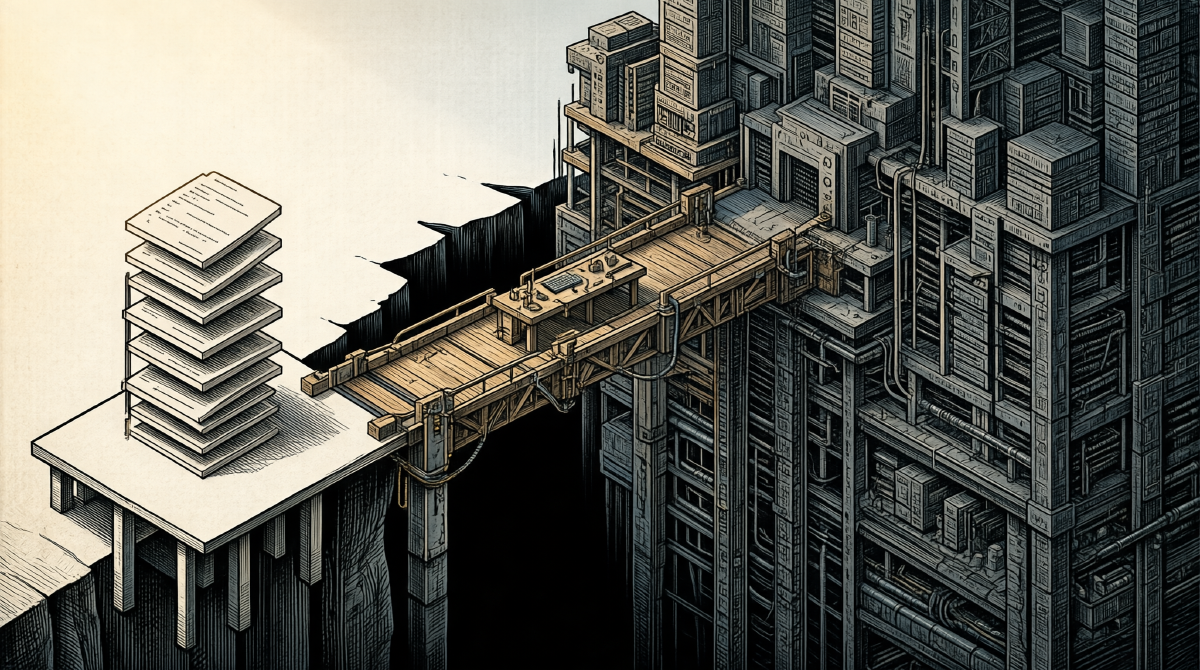
The claude-code-from-scratch project implements a “mini Claude Code” in roughly 3,000 lines of TypeScript. It has the Think-Act-Observe loop, a tool system, a system prompt, permission control, memory, Skills, multi-agent, MCP — every core concept we tore down over the previous ten posts.
And the official Claude Code source? Roughly 500K lines of TypeScript/TSX.
That’s a 100x+ gap between 3,000 lines and 500K. What’s in it?
The gap isn’t “number of features”. from-scratch already covers every core concept. The gap is the road each concept travels from “it runs” to “it’s usable” — that road is called productionization.
Proof of Concept vs. Production-Ready #
from-scratch is a proof of concept. It answers “what are the core principles of Claude Code”. Read its code and you’ll understand how the Think-Act-Observe loop turns, how tools get called, how memory is stored.
Claude Code is a product. It answers “how do a million developers use this tool reliably, every day”.
The two solve entirely different problems:
- A proof of concept solves “can it be done”
- A product solves “is it good, is it stable, does it last”
The distance from “can” to “good” is farther than most people imagine.
Error Handling: From “Hope It Doesn’t Fail” to “Assume It Will” #
from-scratch’s error handling is conceptual: a tool call fails, the error goes back into the conversation history, and the model deals with it. Logically correct, covers the main cases.
Claude Code’s error handling is industrial grade. Beyond “tool call failed”, it handles:
- API rate limits — Anthropic/OpenAI throttling kicks in: degrade how? Switch to a backup model? Queue and retry? Tell the user?
- Network interruptions — the request dies mid-flight: how to recover? Resume from the breakpoint or start over?
- Context overflow — the model returns more than expected and blows past the buffer: how to truncate?
- Concurrency conflicts — several tool calls modify the same file at once: how to coordinate?
- Process crashes — the agent dies mid-run: how to recover? How is session state persisted and rebuilt?
- Encoding issues — what if a file isn’t UTF-8? What if a binary file gets read as text?
- Permission boundaries — the user revokes a permission mid-flight: what happens to the running tool call?
from-scratch assumes “most operations succeed”. Claude Code assumes “everything will fail; it’s only a matter of time”.
That’s not pessimism; it’s engineering discipline. A proof of concept runs under ideal conditions; a product survives hostile ones.
User Experience: From “It Prints” to “It’s Good” #
from-scratch’s UI is basic terminal output — model replies printed straight to the console. It works; you can read it.
Claude Code’s UI is a full terminal application built on Ink (React for CLI). It has:
- Streaming output — every token renders live; no waiting for the full reply
- Structured display — tool calls, file changes, command output distinguished by style and color
- Interactive interface — users can type commands, switch permissions, and inspect state while the agent runs
- Progress indication — spinners and status hints during long operations
- History — previous conversations and tool calls are browsable
This “surface polish” takes enormous amounts of code, but it decides whether users “can use the tool” or “want to use it every day”.
User experience isn’t icing on the product cake; it’s the product’s core competitiveness. Given two tools with identical features, the one with better experience wins users. Especially in AI tooling — human-AI interaction is high-frequency and long-term, and tiny experience differences amplify over daily use.
Performance: From “It Works” to “It’s Fast” #
from-scratch’s performance strategy is “make it run first”. Call the model, wait, execute tools, call again. Serial, blocking, simple.
Claude Code’s performance optimization is multi-layered:
- Request optimization — parallel tool calls, streaming responses, connection reuse
- Caching — file content caches, memory prefetch, tool result caches
- Context management — smart trimming, dynamic compaction, token estimation
- Render optimization — incremental terminal updates instead of full redraws
These aren’t decorations bolted on after “it works”; they evolved step by step as the product grew. Each one maps to a real user’s real pain: “why does reading three files take 5 seconds”, “why do long conversations keep getting slower”.
Maintainability: From “One Person Can Read It” to “A Hundred Can Collaborate” #
A 3,000-line codebase can be read front to back by one person. Slightly blurry module boundaries are fine, sloppy naming is tolerable, thin comments are covered by memory.
A 500K-line codebase demands strict engineering discipline:
- Modularity — clear module boundaries, explicit interface definitions
- Type safety — strict TypeScript constraints, fewer runtime errors
- Test coverage — unit, integration, end-to-end tests
- Documentation — API docs, architecture decision records, contribution guides
- CI/CD — automated build, test, and release pipelines
These practices add code volume (type definitions, tests, and docs “don’t directly produce features”), but they let a large team collaborate on one codebase without stepping on each other.
What’s Actually in Those 500K Lines #
If you sort Claude Code’s 500K lines into buckets, the rough distribution:
- Core agent logic (loop, tools, prompt): ~5%
- UI/terminal rendering (Ink components, streaming, interaction): ~20%
- Tool implementations (detailed implementation and error handling for 30+ tools): ~15%
- Command system (50+ CLI commands): ~10%
- Infrastructure (config management, logging, error handling, session persistence): ~15%
- Tests (unit, integration, E2E): ~15%
- Build and tooling (TypeScript config, CI/CD, packaging): ~5%
- Miscellaneous (MCP client, migration scripts, type definitions): ~15%
Core logic is only ~5%. The other 95% is infrastructure that keeps the core logic running reliably in the real world.
That 95% isn’t sexy. It doesn’t show up in tech blog posts, doesn’t become interview questions, doesn’t get hyped at conferences. But it’s the watershed between product and toy.
The Architectural Abyss From Toy to Product #
“Architectural abyss” isn’t hyperbole. It describes a real phenomenon:
Between a system’s conceptual architecture and its production architecture lies a huge, nonlinear jump in complexity.
There’s no shortcut across. You can’t “design it right from day one” — you don’t know which details matter until real users show up. You can only walk it step by step: build the proof of concept, find users, collect feedback, patch problems, iterate. Every step exposes new details, and every detail demands an engineering decision.
from-scratch’s value is standing you at the abyss’s edge, showing what’s on the other side. Claude Code’s source shows what things look like after crossing.
The road between them has no code to show. It’s made of thousands upon thousands of engineering decisions, each one a judgment of “what’s the better way to handle this”. Some right, some wrong, some compromises. Stack them up and you have a product.
Takeaways #
This comparison isn’t a value judgment of “from-scratch too simple” or “Claude Code too complex”. Each is valuable on its own axis:
- from-scratch’s value is education — it makes you understand the core concepts and build a mental model
- Claude Code’s value is practice — it shows what the concepts look like in the real world
To understand AI agent architecture: read from-scratch first to build the conceptual frame, then read Claude Code to absorb the engineering detail. They complement; they don’t substitute.
Further Reading: Where BYF Sits — Productionization in the Middle #
On the spectrum between “3,000 lines” and “500K lines”, BYF sits in an interesting spot.
BYF isn’t a proof of concept (it runs in production), and it isn’t a 500K-line beast like Claude Code (its core is a few tens of thousands of lines). It lives in the “concept proven, engineering still maturing” stage. That stage has its own challenges:
1. Deliberate layered architecture. ADR 0006 defines BYF’s four layers explicitly (app layer → SDK layer → engine layer → LLM/environment layer). Dependency direction is strict — apps/cli consumes core capabilities only through @byfriends/sdk and never imports agent-core directly. This deliberate layering keeps every BYF subsystem testable and swappable.
2. Proactive design-debt cleanup. BYF has an improve-architecture scanning process that periodically sweeps the source for design debt (type escape hatches, leaking abstractions, confused responsibilities). The TaskEntry discriminated union (ADR 0014) was one scan’s outcome: an as unknown as KaosProcess cast rewritten into a clean type union.
3. Visual debugging tools. BYF’s vis tool (the byf vis command) reads a session’s wire records and renders a browsable timeline. You see every tool call’s timing, every step’s token consumption, every compaction trigger. Claude Code doesn’t have this — BYF chose to “spend more on the debugging experience and not spread thin on core features”.
BYF’s very existence proves the architectural abyss between concept and product can be crossed — one step at a time. Every design-debt cleanup, every ADR decision, every layering refinement lays another brick across the abyss.
Next Up #
This is the series finale. We’ll trace the arc from the Think-Act-Observe loop all the way to the 500K-line engineering abyss, then look further out: the future of AI coding tools — the evolution path from Copilot to autonomous agents, and the development-paradigm shift that “project constitutions” like CLAUDE.md may bring.
This series analyzes the architecture of the official Claude Code source, focusing on design ideas rather than code implementation.