
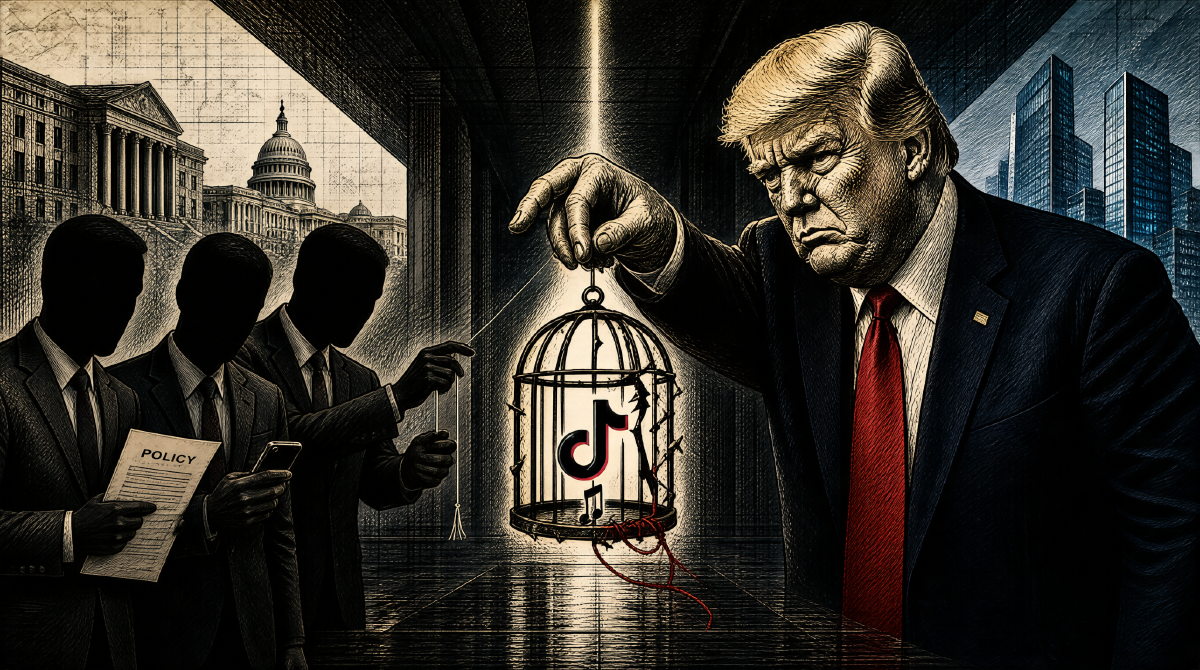
Along the marble corridors of Washington there are no innocent victims—only priced lobbying invoices and bargaining chips laid out on the cutting block. TikTok’s miraculous survival between Capitol Hill and the White House was never a triumph of cross-border corporate virtue; it was an absurd theater of raw power choreographed by Silicon Valley ambushes, K-Street black money, internal corporate purges, and extortion by populist strongmen.
Silicon Valley’s Hidden Daggers and the K-Street Ledger #
Behind the endless congressional hearings, the fingers actually pulling the triggers were rival executives lurking in the shadows.
When Meta’s Instagram Reels and Google’s YouTube Shorts found themselves outmatched across every metric of screen time and algorithmic engagement, Silicon Valley’s monopolists abandoned iterative code improvements. The most cost-effective and immediate defensive countermeasure was to borrow the iron fist of the federal state and physically dismantle their rival under the cover of national security.
Reporting revealed that Meta secretly retained Targeted Victory, a premier Republican public affairs consultancy in Washington, to mount a coordinated smear campaign across dozens of regional newspapers, broadcast outlets, and digital wire services. Carefully fabricated panic pieces flooded the airwaves, blaming TikTok for viral teen delinquencies ranging from vehicle thefts to classroom pranks. Commercial defeat was rebranded into a righteous crusade to defend Western civilization and the mental hygiene of American youth.
Meanwhile, K-Street lobbyists padded silently across dark-red carpets into congressional suites. To avert immediate regulatory execution, ByteDance shelled out tens of millions of dollars in annual lobbying retainers, recruiting former lawmakers, ex-Pentagon advisers, and senior bipartisan chiefs of staff.
Money lubricated every joint of the political machine. Lobbyists pocketed exorbitant retainers from ByteDance while slipping lethal, razor-sharp questions to congressional committee staffers before closed hearings. The bipartisan lobbying network institutionalized security anxiety into a perpetual rent-seeking enterprise. As observed in our ledger on the economic blowback of technological blockades, the moment national security becomes an instrument of commercial predation, regulatory compliance offers zero defense against slaughter.
The Internal Purge: Beijing’s Commissar and Twenty-Nine Thousand Emails #
If external siege provided the pressure, the internal breakdown of TikTok’s own governance provided the poison that drove it toward the abyss. The reporting by investigative journalist Emily Baker-White in Every Screen on the Planet reveals a grotesque anatomy of corporate decay.
In 2020, seeking to placate Washington’s demands for independence, TikTok hired Roland Cloutier—a cybersecurity heavyweight with an Air Force background—as its Global Chief Security Officer. On paper, Cloutier was the immaculate “American face” designed to reassure the Pentagon and CFIUS of the platform’s neutrality.
Yet within a corporate architecture characterized by centralized control in Beijing, Western compliance frameworks were little more than cardboard facades. Long before Cloutier arrived, Chris Lepitak, a founding veteran reporting straight to the parent company’s executive suite, had established total control over internal audits. Lepitak bypassed nominal subsidiary CEO Shou Zi Chew entirely. Whenever Cloutier attempted to map out sensitive data flows under US legal protocols, he ran headlong into information blockades erected by Beijing.
By late 2021, bureaucratic friction erupted into an outright political purge. Bypassing legal oversight, Lepitak retained private investigators to rifle through all 29,293 of Cloutier’s corporate emails across a grueling nine-month investigation. While this witch hunt uncovered zero graft, it succeeded in humiliating and neutralizing the Chief Security Officer, forcing his eventual resignation. At the exact juncture when congressional scrutiny reached fever pitch, TikTok’s leadership had torn away its own most expensive compliance facade from the inside.
Project Texas—a multi-billion-dollar initiative to isolate US data on Oracle’s cloud—collapsed into a monumental engineering boondoggle. The server racks were purchased, but the codebase inherited from thousands of engineers in China remained an impenetrable labyrinth. Critical administrative tools, revenue engines, and content-moderation backends were riddled with untranslated Chinese comments and tangled permission hierarchies. American engineers tasked with auditing the infrastructure were baffled by the systems they were paid to defend. What was conceived as a showcase of algorithmic isolation became, in the eyes of Washington hawks, an indefensible black box of self-incrimination.
Self-Mutilation: The Populist Nuclear Gamble #
Under the Biden administration, as federal legislative machinery ground forward, TikTok’s legal moderates were pushed aside. Hardline chief lobbyist Michael Beckerman assumed operational command, staking the company’s survival on a self-destructive political gamble.
Beckerman sought to replicate Uber’s early municipal playbook: bypassing institutional diplomacy to unleash users directly against federal lawmakers.
The platform pushed an unclosable full-screen alert to 170 million American users, stripping away “skip” and “dismiss” buttons. Bold red type screamed that Congress was preparing to steal their beloved platform, paired with a single-tap gateway auto-dialing local congressional switchboards.
Within hours, Capitol Hill’s telephone exchanges melted down. Thousands of frantic teenagers and children overwhelmed switchboard operators with tearful tirades and death threats against elected representatives.
This populist stunt struck the raw nerve of the Washington establishment. Lawmakers realized with dread that a foreign-controlled platform possessed the switchboard capability to mobilize tens of millions of domestic citizens within minutes, weaponizing their outrage directly against the seats of constitutional governance.
Terror catalyzed swift retaliation. The House Energy and Commerce Committee, typically paralyzed by partisan rancor, voted unanimously 50-0 within days to advance the divest-or-ban statute. As detailed in our breakdown of the NYC populist showdown and the establishment counter-strike, any populist agitation lacking institutional coercive force that openly threatens the sovereign security of a ruling class will inevitably face total systemic annihilation.
The Loyalty Pageant: An Inaugural Sacrificial Rite #
When legal appeals, public relations spin, and user mobilizations lay in smoking ruins, TikTok’s executives discarded the polite fiction of corporate governance. They retreated to the oldest, crudest instinct in the history of power: groveling before the personal authority of a strongman.
Constitutional homilies and First Amendment briefs were tossed aside. Every remaining chip was shoved toward Donald Trump. Oracle founder and major political donor Larry Ellison served as the backchannel broker. Trump casually tossed out demands on the campaign trail for billions of dollars in extortion money to establish a “patriotic history education fund.” In response, TikTok fired its legal team, retained Trump’s personal counsel, and inserted into court briefs a statement defying constitutional separation of powers: that the incoming president alone holds the supreme authority to determine TikTok’s fate.
The crowning performance occurred on the eve of the presidential inauguration.
Without any court order taking effect, TikTok voluntarily pulled the plug, plunging millions of American users into darkness. The blackout screen broadcast a clear political message: “We are fortunate that President Trump is working to bring TikTok back online.”
Hours later, the moment the new president concluded the oath of office, the application “miraculously” revived. A notification blanketed every American handset, expressing humble gratitude to Trump for personally saving the platform.
It was an impeccably staged, groveling imperial tribute. The brief outage involved zero technical failures and zero legal developments—only a multinational tech monopoly offering its absolute surrender before a ruler on live television.
Faced with naked sovereign will, the myth of algorithmic neutrality is exposed as vapor. The collective attention of hundreds of millions of citizens was reduced to a private transactional offering. This is the final terminus for tech capital in the geopolitical meat grinder: once the masks of institutional order fall away, the summit of corporate wisdom is simply knowing which strongman to kneel before, and ensuring you hit the floor harder than anyone else.